
Left to Right: Richard Anuszkiewicz, Temple to Sunset #754, acrylic on canvas, 1985; Frank Stella, Untitled, (from 10 x 10 portfolio), silkscreen, 1964; Gabriele Evertz, Motion Parallax, acrylic on canvas, 1998.
Tuesday, July 17, 2007
Op Art: Then and Now, Columbus Museum of Art, Columbus, OH, July 6 - September 30, 2007
Yaacov Agam, Anni Albers, Edna Andrade, Richard Anuszkiewicz, Linda Besemer, Gabriele Evertz, Paul Feely, Beverly Fishman, Peter Halley, Sally Hazelet Drummond, Christopher Herron, Bill Komodore, Reginald Neal, Greg Russel, Julian Stanczak, Frank Stella, Tadasky, Victor Vasarely


Saturday, July 7, 2007
Helga Groves, Sutton Gallery, 254 Brunswick St., Fitzroy, Melbourne, Australia, July 12-August 11, 2007
For more information including catalog essays, click here
Friday, June 8, 2007
Points of Departure: Six Australian Artists, Tobey Fine Arts, New York, NY, May 3-June 30, 2007
John Aslandidis, Richard Bell, Cathy Blanchflower, Christopher Dean, Helga Groves, and Matthew Johnson

John Aslandis, Sonic Current No 1 (2006), Oil and Acrylic on canvas, 42" x 50"

Cathy Blanchflower, Xenon VI (2007), Oil on canvas, 58" x 48"

Helga Groves, Precipitation (2007), oil, pigement and medium on canvas, 39.5" x 55'

John Aslandis, Sonic Current No 1 (2006), Oil and Acrylic on canvas, 42" x 50"

Cathy Blanchflower, Xenon VI (2007), Oil on canvas, 58" x 48"

Helga Groves, Precipitation (2007), oil, pigement and medium on canvas, 39.5" x 55'
1950s-1960s Kinetic Abstraction, Andrea Rosen Gallery, June 27-August 24, 2007, New York, NY
Hartmut Böhm, Gianni Colombo, Gerhard von Graevenitz, Julio Le Parc, Heinz Mack, François Morellet, Jesús Rafaël Soto, and Jean Tinguely. Curated in collaboration with Erika Hoffmann

Hartmut Böhm, "Quadratrelief 66," 1970, 104 x 104 x 4 cm, Plexiglas, Museum Tel Aviv, Tel Aviv, Gift from the McCrory Collection, New York
http://www.andrearosengallery.com/exhibitions/2007_6_1950-s-1960s-kinetic-abstraction/

Hartmut Böhm, "Quadratrelief 66," 1970, 104 x 104 x 4 cm, Plexiglas, Museum Tel Aviv, Tel Aviv, Gift from the McCrory Collection, New York
http://www.andrearosengallery.com/exhibitions/2007_6_1950-s-1960s-kinetic-abstraction/
Sunday, May 6, 2007
Grid: Process and Structure, Wooster Art Space, New York, NY, April 3-April 28, 2007
Joel Carreiro, Creighton Michael, Beatrice Riese, Sanford Wurmfeld. Organized by the Osilas Gallery, Concordia College.
Friday, May 4, 2007

Thursday, May 3, 2007
Op Art in Artforum

Lengthy reviews of the Optic Edge show in Columbus and the Op Art show in Frankfurt by David Rimanelli and Sarah K. Rich in the May 2007 Artforum.
Tuesday, April 24, 2007

Ray Thorburn: Line on Line, Te Manawa, New Zealand, March 10 to July 15, 2007

Afterimage: Op Art of the 1960s, Jacobson Howard Gallery, New York, NY, March 8 - April 28
Jacobson Howard Gallery with Yaacov Agam, Josef Albers, Ricahrd Anuszkiewicz, Hannes Beckmann, Fletcher Benton, Karl Benjamin, Francis Celentano, Carlos Cruz-Diez, Benjamin Cunningham, Gene Davis, Leroy Lamis, Jose De Rivera, Julio Le Parc, Alexander Lieberman, Francois Morellet, Kenneth Noland, Larry Poons, Bridget Riley, Julian Stanczak, Frank Stella, Luis Tomasello, Victor Vasarely

Leroy Lamis, Construction #31, 1963, Plexiglass ,12 x 12 x 12 inches

Francis Celentano, Undulating Units (1968), acrylic on canvas, 36" x 90"

Leroy Lamis, Construction #31, 1963, Plexiglass ,12 x 12 x 12 inches

Francis Celentano, Undulating Units (1968), acrylic on canvas, 36" x 90"
Monday, April 23, 2007
Sensational: Edna Andrade’s Drawings, Woodmere Art Museum, Philadelphia, PA, March 25- June 24, 2007
This is the first show to span the entirety of Andrade's complicated career, from representational land/seascapes from the fifties, through pioneering op paintings from the sixties, seventies and eighties, and back to land/seascapes in the ninties through this century. It features nearly 60 drawings and paintings on paper.
For Philadelphia Inquirer review of this show, click here.
A 32 page color catalog of this show is available.
For Philadelphia Inquirer review of this show, click here.
A 32 page color catalog of this show is available.
Sunday, April 22, 2007
Carlos Cruz-Diez, Sicardi Gallery, Houston, TX, March 16 - May 12
http://www.sicardi.com/artists/detail.cfm?artworkid=1085
http://www.cruz-diez.com/
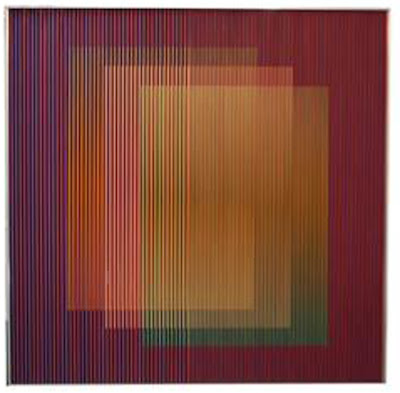
http://www.cruz-diez.com/
"Physichromie No 2413" (2002)
Aluminum and plexiglass
100 x 100 cm
Friday, March 23, 2007
Optic Nerve: Perceptual Art of the 1960s, Columbus Museum of Art, Columbus, Ohio, February 16 - June 17, 2007

Ed Mieczkowski, Blue Bloc, 1967, acrylic on canvas, 48" x 48"
Curator Joe Houston has put together the most important international surevy of op art in years, with approximately 85 op and op-related pieces, with a focus on the 1960s. The 200 page catalog is the first overview of op availalbe since the early seventies includes an introductory essay by Dave Hickey. Columbus is a JetBlue city so don't miss this show!
For or more images and information, go to:
Agam, Anni Albers, Josef Albers, Getulio Alviani, Edna Andrade, Richard Anuszkiewicz, Marina Apollonio, Hannes Beckmann, Karl Benjamin, Ernst Benkert, Francis Celentano, Toni Costa, Carlos Cruz-Diez, Benjamin Cunningham, Gene Davis, Sally Hazelet Drummond, Angel Duarte, Wojciech Fangor, Paul Feeley, Lorser Feitelson, Karl Gerstner, Francis Hewitt, Robert Irwin, Ellsworth Kelly, Bill Komodore, Edorado Landi, Mon Levinson, Alexander Liberman, Wolfgang Ludwig, Edourdo Mac Entyre, Heinz Mack, Agnes Martin, Almir da silva Mavignier, Ed Mieczkowski, Francois Morellet, Spencer Moseley, Rakuko Naito, Reginal Neal, Kenneth Noland, Henry C. Pearson, Larry Poons, Bridget Riley, Peter Sedgley, Tony Smith, Jesus Raphael Soto, Julian Stanczak, Jeffrey Steele, Frank Stella, Tadasky, Luis Tomasello, Claude Tousignant, Vicotr Vasarely, Gerhard von Graevenitz, Ludwig Wilding, Jean-Pierre Yvaral.
Saturday, March 17, 2007
Optic Nerve Catalog (first op survey in English in 35 years)

The best overview of op art ever published (and the first in some 35 years.) This is the accompanying catalog for the show on view at the Columbus Art Museum through June 17. Fetures many color plates, introductory essay by Dave Hickey (click here for excerpts), and excellent text by curator Joe Houston. Support this important exhibition and buy from the museum directly (call (614) 221-4848).
Wednesday, March 7, 2007
"The Optical Edge," Pratt Manhattan Gallery, New York, NY, Mar 7-Apr 14, 2007
Read the essay "Reviving the Edge in Optical Painting" by Robert C. Morgan.
with Bridget Riley, Richard Anuszkiewicz, Julian Stanczak, Victor Vasserely, Josef Albers, Sandford Wurmfeld, Robert Swain, Gabriele Evertz, Rakuko Naito, Gilbert Hsiao, Soon Ja Han, Jon Groom, Beverly Fishman, Ryszard Wasko, and Michelle Hinebrook. Curated by Robert C. Morgan. A catalog is available for this exhibition.
Click here for good notes made by Marshall Sponder at the artist talk on March 9 with Sandford Wurmfeld, Soon Ja Han, Jon Groom, Ryszard Wasko and Robert C. Morgan.

Gabriele Evertz, Motion Parallax, 1998
Acrylic on canvas, 72 x 72 inches
with Bridget Riley, Richard Anuszkiewicz, Julian Stanczak, Victor Vasserely, Josef Albers, Sandford Wurmfeld, Robert Swain, Gabriele Evertz, Rakuko Naito, Gilbert Hsiao, Soon Ja Han, Jon Groom, Beverly Fishman, Ryszard Wasko, and Michelle Hinebrook. Curated by Robert C. Morgan. A catalog is available for this exhibition.
Click here for good notes made by Marshall Sponder at the artist talk on March 9 with Sandford Wurmfeld, Soon Ja Han, Jon Groom, Ryszard Wasko and Robert C. Morgan.
Gabriele Evertz, Motion Parallax, 1998
Acrylic on canvas, 72 x 72 inches
Thursday, March 1, 2007
"Seurat and the Neo-Impressionists," Robert H. and Ina M. Mohlman Gallery at the Indianpolis Museum of Art (Ongoing)
The Indianapolis Museum of Art boasts one of the finest, if not the finest, collection of neo-impressionist painting in the United States. Currently, it is displaying 16 paintings, a watercolor, and a print as part of its regular collection. Besides work by Pissaro, Seurat and Signac, there is fine work by Paul Baum, Hendricus Petrus Bremmer, Henri Edmond Cross, Alfred Finch, Georges Lemmen, Maximilien Luce, George Morren, Albert Dubois-PilletLucien Pissaro, Jan Toorop, and Henry van de Velde. Click here for images.

Jan Toorop, Dutch (1858-1928), Broek in Waterland (1889), oil on canvas

Jan Toorop, Dutch (1858-1928), Broek in Waterland (1889), oil on canvas
The museum is newly renovated and features extensive collections of European paintings (14th century onward, including a Caravaggio, plus a collection of Turner and Turner related watercolors), American paintings (check out the unique underwater Thomas Moran landscape) as well as extensive Asian and African collections. It has a good op and post-op collection as well (currently on view is an uncharacteristic early Bridget Riley, a Roy Lichtenstein dot print of a Monet cathedral, one of the few, in my opinion, successful representational op works, and light based installations by Robert Irwin, James Turrell, and Michael Rovner with optical implications.)
Thursday, February 22, 2007
Op Art Revisited: Selections from the Albright-Knox Art Gallerly, San Jose Museum of Art, San Jose, CA, Jan 28 - April 22, 2007

Victor Vasarely, Bora II, 1964
Participating artists include Josef Albers, Bridget Riley, Julian Stanczak, Richard Anuskiewicz, Larry Poons, Rogelio Polosello, Julio Le Parc, Karen Davie, Howard Jones, Heinz Mack, Paul Talman, Tadasky (Kuwayama), Jesus Raphael Soto, Karl Gerstner, Josef Levi, Francesci Celentano, Jean-Pierre Yvaral, Yaacov Agam, Victor Vasarely, Susie Rosmarin, and Tim Bavington. Many of the images, though small, were in the Extreme Abstraction show at the Albright Knox Art Gallery in 2005 and can be seen at http://66.251.89.230/detail.php?t=events&type=related&kv=2893
Julian Stanczak Talks About His Work (and Pulls the Tape Off of His Paintings) in Columbus Post Video Clip

I think this is actually an excerpt from one of 2 dvds (The Perceptive Eye and Color Symphony: Artistic Process) which are, or at least, were, avaialable through Stux Gallery in New York. If you have trouble there, try his website (see post elsewhere on this blog)
http://www.columbusdispatch.com/multimedia/multimedia.php?story=dispatch/2007/extras/opart/opart.html
Also, see the February 11 story in The Columbus Dispatch at http://www.columbusdispatch.com/features-story.php?story=dispatch/2007/02/11/20070211-D1-00.html
Schirn Kunsthalle Frankfurt, Frankfurt, Germany, Feb. 17-May 20, 2007

For list of participating artists, see
http://www.schirn-kunsthalle.de/index.php?do=exhibitions_detail&id=74&lang=en
Click here for review with photos: http://www.coolhunting.com/archives/2007/02/op_art_at_schir.php
Julian Stanczak's Website

Anywhere-Everywhere, 1967, 76x76"
Stanczak's career is documented in images nicely at
Wednesday, February 21, 2007
Edna Andrade, Optical Paintings, 1960-1966, Locks Gallery, Philadelphia, PA, Jan 19-Feb 24, 2007

Radiant Ellipse 3-65, 1965. oil on linen, 47 1/4 x 47 1/4 inches
For more images go to http://www.locksgallery.com/exhibit/2007/andrade/andrade07.html
Sunday, February 11, 2007
Mark Dagley & Don Voisine, McKenzie Fine Art Inc, New York, NY, January 11 - February 10, 2007
 Mark Dagley, Neutral Value Vortex, 2006, Acrylic and pencil on canvas, 84 x 84 inches
Don Voisine, Reason, 2006, Oil on wood, 26 x 15 inches
All work in this show is on view at http://www.mckenziefineart.com/exhib/DagleyVoisineexhb.html
Wednesday, January 24, 2007
Thursday, January 11, 2007
Edna Andrade, Philadelphia Inquirer article, January 11, 2007
An Op Art Original
Over the decades, Edna Andrade created stunning canvases of complex visual images. Now, a new swirl of attention is coming her way.
By Amy S. Rosenberg
Philadelphia Inquirer Staff Writer
In the '60s, she was making art that was part of the psychedelic fabric of its day, mind-blowing optical trickery, paintings that vibrated and moved, art that anticipated a digital medium few had imagined.
But Edna Andrade was no hippie, no part of the like-wow drug culture that embraced the op art movement of the 1960s.
She was middle-aged, living on her own on Carlisle Street in Center City, her architect husband having left her, isolated from the New York or European art scene, no starving waitress thing for her, no East Village bohemia.
"My cleaning lady was the only person allowed to clean in the studio," Andrade says. "When she would come in and say, whooah, I knew it was good."
Now, on the eve of her 90th birthday, it is, frankly, the ladies in the cafeteria of her assisted-living high-rise near 17th and Callowhill that this important but under-recognized artist more often than not eschews, with their join-me-for-dinner dance cards annoyingly booked until eternity.
Up in her penthouse apartment, she's still reading her New York Review of Books, still organizing her fruit and vegetables in an amusingly geometric mimicry of her art, still game enough to be offering up a vodka martini, even mid-afternoon, to her guests, and still showing a cheerful edginess as sharp as the oil-painted lines she so painstakingly created with a ruling pen.
She hasn't touched the unfinished painting in her workroom - a return to the landscape painting she did as an art student inspired by the summers she spent in Maine with her great friend George Bunker, dean of fine arts at the University of Houston - for a year.
She says, matter of factly: "Right now, I have not been able to work and I don't have any ideas. I have been busy as a bird dog trying to get rid of my stuff, and trying to get ready to die. I made more money this year than I ever made. I think people are finally catching up with me."
Indeed, Andrade, whose birthday is Jan. 25, is in the midst of a renewed interest in her work, and in the op art movement in general. "I just sold this after 40 years," she says of one painting, Interchange, from 1966, a turquoise and red canvas of 3D-like boxes and polka dots that alternately flattens and takes on dimension as you stare at it. "I didn't sell a lot of this stuff when I did it. Now people are collecting it."
The Locks Gallery on Washington Square, which has represented Andrade for more than three decades, is planning a party for her on Jan. 20. The University of the Arts, where she taught for 30 years, is unveiling a scholarship fund in her name on March 1. And the Woodmere Art Museum in Chestnut Hill will exhibit her works in a special retrospective, opening March 28.
The Philadelphia Museum of Art, which owns a dozen of her works, is now exhibiting a major painting of hers, Color Motion 4-64, as part of its Pop Art and Its Affinities exhibition in the American Art gallery, room 119 on the first floor. And she is a central figure in a major exhibition, Optic Nerve, planned for next month at the Columbus Museum of Art, in Ohio.
Columbus curator Joe Houston says Andrade represents "the pinnacle of what artists were doing" in the op art era, during which the viewing experience was primary, and the science of perception and visual immersion anticipated this era's light shows, film installations and other digital media. He includes Andrade's name with internationally known op art figures such as Brigit Riley and Victor Vasarely.
Andrade's mind - which for four decades has produced canvases of intricate and complex visual and geometric imagery (you want to see something deeper, symbolically or whatever else, that's your issue, Andrade says) - that mind, man, it still hums like one of her paintings.
"It's not like showing your emotion," she says of her art. "It was very cool art. It's a decision to be totally visual. A story doesn't go with it."
As to the whole trippy quality of the movement, she quips: "I was so sorry it was connected to that because I did it cold sober." (Though she did try a joint once at a party of University of the Arts students. "I took a drag and it did nothing for me," she said. "The liquor was enough.")
Born near Norfolk, Va., Andrade came to Philadelphia to study at the Pennsylvania Academy of the Fine Arts at the age of 16. During World War II, she worked on propaganda materials for what is now the CIA. After a brief stay in Bucks County, which her husband loved and she hated, they returned to Center City, but her marriage was soon over, she says.
In retrospect, she says, the end of her marriage allowed her artistic life to flourish, though her art was greatly influenced by the time at her husband's architectural drafting table.
"I think I would not have accomplished as much if I'd stayed married," she says. "I was playing second fiddle, doing drafting work. I didn't really take charge of my career until middle age."
These days, there's a lot of Andrade-induced "whoa" going on over at the Philadelphia Museum of Art, where Color Motion 4-64 hangs.
The painting, four checkerboards of differently sized squares, never stops humming. Walk around the room and look at it from different angles, it starts morphing into an hourglass sort of thing. Look for too long, you'll get dizzy, or feel as if your eyes are playing tricks on you. How can paint on canvas be constantly in motion?
"It messes with your eyes," says Ramona Mabin, the security guard in the room, who is on guard more for finding herself staring too long at the work, with its hypnotic qualities, and its op art companion next to it, a tunnel-into-infinity kind of work of orange concentric target-like squares by Richard Anuszkiewicz, titled Knowledge and Disappearance.
Back in the 1960s, Sears took the image for wallpaper, which was what happened to a lot of the op art images; they became fabric and posters and album covers. The original artistic creations got a bit co-opted by the design culture it spawned (Andrade herself has several pillows in her living room that feature her colorful and pulsating images).
Ask Andrade to explain how she composed a work like Color Motion, and you see how this perceptually intricate work is, at its heart, a function of lines and shapes and a connect-the-dots kind of geometrical precision. "Square by square, just like life," she says, drawing a bit of deeper meaning herself. "Nice stable brushes."
Or, more precisely: "I had already done a drawing, dividing up the canvas into four sections. I have then drawn a circle. I've mapped out the increments, drawn lines through those points, and that generated those squares. Your eye tries to appreciate this gradation. The scientists, they loved it. They understood some of the geometry of it."
While living in Philadelphia may have resulted in less recognition nationally and internationally, she says the city has been very good to her, though many times, especially during the op art decades, she felt like a community of one.
"I was about the only one doing that in Philadelphia," she says. "But I was not ready to move to New York and wait on tables. I would have wound up an old waitress - not an old artist."
Edna Andrade's Artwork
Her work can be seen at the Locks Gallery, 600 Washington Square South, Philadelphia.
The Philadelphia Museum of Art, which owns a dozen of her works, is exhibiting one of her major paintings, "Color Motion 4-64," as part of its Pop Art and Its Affinities exhibition in room 119 of the American Art wing.
She will be part of a major pop-art exhibition next month at the Columbus Museum of Art in Ohio.
And the Woodmere Art Museum in Chestnut Hill will exhibit her works in a special retrospective, opening March 28
Images of Andrade and her work from same article
http://inquirer.philly.com/slideshows/Features/070111dm1edna/
Monday, June 26, 2006
Bridget Riley, New Paintings and Goucahes, June 7 - July 28, 2006, Timothy Taylor Gallery, London

January 29, 2006 (2006) gouache on paper
For more iamges and statement, go to http://www.timothytaylorgallery.com/index_1024.html
For more iamges and statement, go to http://www.timothytaylorgallery.com/index_1024.html
Wednesday, February 22, 2006
Susie Rosmarin, Danese Gallery, New York, NY, March 24-April 22, 2006

(#361) Untitled, 2006, acrylic on canvas, 40 x 40 inches
For more images, see http://www.danese.com/Main/Artists/Rosmarin/ROSM_10.html
Monday, February 6, 2006
Presentational Painting III, Hunter College/Times Square Gallery, New York City, February 16-April 15, 2006
Hartmut Bohm, Paul Corio, Daniel Crews, Matthew Deleget, Lynne Harlow, Gilbert Hsiao, Changha Hwang, Susanne Jung, Steve Karlik, Rossana Martinez, Charlotte Nicholson, Francisca Reyes, Steven Salzman, Martjin Schuppers, Mike Stack, Don Voisine. Curated by Gabriele Evertz, w. John Cox and Abbey Ryan. For artnet Magazine review by Stephen Maine click here. Click here for installation shots.

Paul Corio, BC Juvenile, acrylic on panel, 8.5" x 10.5", 2006
Presentational Painting is a term coined by Sanford Wurmfeld. In the catalog to an earlier exhibiton of Presentional Painting in 1993, he wrote:
"Presentational art...refers to art structured by a human being and presented as a statement, a visual fact, to be expereienced or received by an active viewer. By its sensory nature, such art is untranslatable and the ideas or feelings transmitted by it are tied to the particular object that expresses them."
Still earlier, in 1985 in an exhibition for a show entitled "Color Documents: A Presentational Theory" he wrote:
Presentational Painting is a strain of modern art that originated around 1920 when painting departed entirely from reproduction and thus representation of the object. It stands at opposite ends to abstraction and must be distinguished from it since abstraction denotes art that does not relinquish its relationship to the exterior. But it is important to note that abstraction paved the way for a greater consideration of the role of viewer participation. By definition Presentational Painting is concerned with the account of meaning that is inherent in the painting itself. It is an art that has persisted in the face of resistance and has held its own against many other styles. The specialized approach to concentrating on perceptual phenomena, clarity of its organizing principles and affinity to logic gives rise to pictorial effects that are surprising despite its grounding in calculability and foresight. The pictorial possibilities are still expanding. The striking spatial and kinetic aspects of color interactions are especially astounding to observe. It is this consistency of the search for innovation and diversity that gives the practice its vitality. But to ensure continuation it requires the rethinking and reworking of the critical criteria that informs our expectation for this mode of expression today. "
"...it is the manipulation by the artist of the physical variables--the paint quality, the flat surface, and the size and shape of the support--together with an understanding of the relation of these variables to predictable visual structures, that is fundamental to esthetic meaning in paintings, and the basis of presentational art."

Paul Corio, BC Juvenile, acrylic on panel, 8.5" x 10.5", 2006
Presentational Painting is a term coined by Sanford Wurmfeld. In the catalog to an earlier exhibiton of Presentional Painting in 1993, he wrote:
"Presentational art...refers to art structured by a human being and presented as a statement, a visual fact, to be expereienced or received by an active viewer. By its sensory nature, such art is untranslatable and the ideas or feelings transmitted by it are tied to the particular object that expresses them."
Still earlier, in 1985 in an exhibition for a show entitled "Color Documents: A Presentational Theory" he wrote:
Presentational Painting is a strain of modern art that originated around 1920 when painting departed entirely from reproduction and thus representation of the object. It stands at opposite ends to abstraction and must be distinguished from it since abstraction denotes art that does not relinquish its relationship to the exterior. But it is important to note that abstraction paved the way for a greater consideration of the role of viewer participation. By definition Presentational Painting is concerned with the account of meaning that is inherent in the painting itself. It is an art that has persisted in the face of resistance and has held its own against many other styles. The specialized approach to concentrating on perceptual phenomena, clarity of its organizing principles and affinity to logic gives rise to pictorial effects that are surprising despite its grounding in calculability and foresight. The pictorial possibilities are still expanding. The striking spatial and kinetic aspects of color interactions are especially astounding to observe. It is this consistency of the search for innovation and diversity that gives the practice its vitality. But to ensure continuation it requires the rethinking and reworking of the critical criteria that informs our expectation for this mode of expression today. "
"...it is the manipulation by the artist of the physical variables--the paint quality, the flat surface, and the size and shape of the support--together with an understanding of the relation of these variables to predictable visual structures, that is fundamental to esthetic meaning in paintings, and the basis of presentational art."
Monday, September 5, 2005
Obsessive Drawing, American Folk Art Museum, New York, NY, Sept 14, 2005 - March 19, 2006
Eugene Andolsek, Martin Tompson, Hiroyuki Doi, Chris Hipkiss

Eugene Andolsek, Date Unknown, Untitled, India Ink on Paper

Eugene Andolsek, Date Unknown, Untitled, India Ink on Paper
Friday, August 12, 2005

Tuesday, July 5, 2005
Manfred Kuttner, Johan Koening, Berlin, Germany, July 2-August 13, 2005
For more information, click here.

Sunday, March 6, 2005

Friday, February 25, 2005
Kinetic Art at Praguebieneale 2, Prague, Czecholslavakia, May 16 - Sept 15, 2005

Curated by Getulio Alviani. For list of 29 participating artists, see
Monday, February 21, 2005

Saturday, October 16, 2004
Vicotr Vasarely, Black and White Paintings from the 1950s, Robert Miller Gallery, New York, NY, October 16-November 13, 2004
 Bi-Supernovae, 1961
For more images: http://www.robertmillergallery.com/
-Double click to enter site
-Double click again to find "artists" (in tiny type)
-Double click artists
-Place mouse arrow on down arrow (names start to scroll)
-When Vasarely's name appears, remove mouse arrow from down arrow on screen
-Double click Vassaely's name
-Double click "Images" or "Press Release"
Artnet biolgraphpy:
http://www.artnet.com/Galleries/Artists_detail.asp?G=&gid=754&which=&aid=17122&ViewArtistBy=online&rta=http://www.artnet.com/ag/fulltextsearch.asp?searchstring=vasarely
Saturday, November 22, 2003
Susie Rosmarin, New Paintings, Texas Gallery, Houston, TX, November 22 - December 27, 2003

Deep Blue (#299), 2003, Acrylic on Canvas, 50 x 60"
For more images, see http://www.texgal.com/Rosmarin/index.htm
Monday, July 7, 2003
Horst Bartnig, Ulrich Müller, Berlin, Germany, June 14-August 30, 2003
For more information, click here
Saturday, January 18, 2003
Edna Andrade: Optical Paintings, 1963-1986, Insitute of Contemporary Art, University of Pennsylvania, Philadelphpia, PA, January 18-April 6, 2003

This was a major show with a nice 74 page color catalog still in print and available from the ICA at http://www.icaphila.org/shop/publications.php.
For original press release and images, see http://www.icaphila.org/exhibitions/past/andrade.php
For Art in America review written by Anne Fabri, go to http://www.findarticles.com/p/articles/mi_m1248/is_11_91/ai_110963168
Saturday, March 9, 2002

Saturday, February 24, 2001
Sanford Wurmfeld, "Cyclorama," Karl Ernst Osthaus-Museum, November, 2000-March, 2001

At Karl Ernst Osthaus-Museum, November, (2000-March, 2001), see
For good photos of model, see http://www.mohr-i.nl/content.phtml?793
At Edinburgh Festival, Edinburgh, Scotland, (2004), see http://www.ed.ac.uk/news/circular.html
Wednesday, March 1, 2000

Friday, May 14, 1999
Post Hypnotic, University Galleries, Illinois State Univ, Normal, IL
John Armleder, Ross Bleckner, Stratton Cherouny, David Clarkson, Mark Dagley, Karen Davie, Steve Di Benedetto, Michelle Grabner, Ted Griffin, Peter Halley, Jim Isermann, Yayoi Kusama, Judy Ledgerwood, Jason Martin, Tom Martinelli, Tom Moody, Sarah Morris, Aaron Parazette, Bruce Pearson, Walter Robinson, Susie Rosmarin, Peter Schuyff, Michael Scott, James Siena, David Szafaranski, Philip Taaffe, Fred Tomaselli, Yek
Curated by Barry Blinderman
This show started on January 12, 1999. It was subsequently presented in Dallas, Cincinnati, Atlanta, Chicago and Duluth.

Click here for Artforum review of this show.
Click here to purchase copy of exhibtion catalog from Amazon.com.
Curated by Barry Blinderman
This show started on January 12, 1999. It was subsequently presented in Dallas, Cincinnati, Atlanta, Chicago and Duluth.

Click here for Artforum review of this show.
Click here to purchase copy of exhibtion catalog from Amazon.com.
Tuesday, March 2, 1999
Dynamic Oppositions: Venezuelan Abstract-Constructive Art from the Patricia Phelps de Cisneros Collection, Blanton Museum of Art, Austin, TX Sept 1999
 Eduardo Mac Intyre
Pintura generativa (Generative Painting),1967, Oil on canvas, 31 3/8 x 31 3/8 inches
An AMAZING survey featuring many strong op works from Venezuela. I haven't found a good central way to navigate the whole site; go room by room and click on the images, or start at the first image and keep clicking on the arrows.
Despcription of the exhibition: http://www.utexas.edu/cofa/bma/cisneros/
Room 1: http://www.utexas.edu/cofa/bma/cisneros/room_no1.html
Room 2: http://www.utexas.edu/cofa/bma/cisneros/room_no2.html
Room 3: http://www.utexas.edu/cofa/bma/cisneros/room_no3.html
Room 4: http://www.utexas.edu/cofa/bma/cisneros/room_no4.html
Room 5: http://www.utexas.edu/cofa/bma/cisneros/room_no5.html
Friday, February 27, 1998
UP & CO, New York, NY, May 16-July 18, 1998

From the blog of Tom Moody. This exhibiton featured Mark Dagley, Tom Moody, David Clarkson, Ray Rapp, and Alicia Wirt. For exhibtion images and "manifesto," go to http://www.digitalmediatree.com/tommoody/op90s/ For reviews by Carol Kino and J. Bowyer Bell, go to http://www.digitalmediatree.com/tommoody/opatup/.
Wednesday, February 25, 1987
The Artist's Eye Curated by Bridget Riley, National Gallery, London, 1987
A nearly half hour film was made in conjunction with this show. For a brief clip, go to http://www.rolandcollection.com/home.aspx#D584

Titian, Bacchus and Ariadne, (1520-1523)


Rubens, 'Minerva protects Pax from Mars ('Peace and War') (1629-30)

Titian, Bacchus and Ariadne, (1520-1523)

Veronese, The Adoration of the Kings(1573)

El Greco, Christ Driving the Money Leanders from the Temple (ca. 1600)

Rubens, 'Minerva protects Pax from Mars ('Peace and War') (1629-30)


+Interior+of+the+Studio,+1887,+oil+on+canvas.JPG)

+72.jpg)


Monday, April 15, 1985
Color Documents: A Presentational Theory, Hunter College, April 15 - June 7, 1985, New York, NY
This interesting exhibition, curated by artist Sanford Wurmfeld, consisted of some 60 documents dating from the 18th century onwards relating to the classification of color, mostly in the form of color charts. A nice catalog catalog accompanied the show, which may still be available.
Along the same lines, see http://www.colorsystem.com/ for a comprehensive site devoted to the history of the study of color.
Along the same lines, see http://www.colorsystem.com/ for a comprehensive site devoted to the history of the study of color.
Friday, April 24, 1970
Op Art: Pictures That Attack the Eye, Time Magazine, October 23, 1964
!964 Time magazine article on op art.
Go to http://www.time.com/time/magazine/article/0,9171,897336-1,00.html
Go to http://www.time.com/time/magazine/article/0,9171,897336-1,00.html
Subscribe to:
Posts (Atom)